


Upwelling follows this movement as a metaphor. Amid collapsing ecosystem and accelerating species loss, sorrows converge, despair bubbles to the surface, and a collective grief becomes conscious.
Rather than drown in sorrow, there must be ways to refill our lungs with air, wade through the anguish and return with the tide. To find breaks in the swell, make room for renewal and bear the storm in defiance.
While honouring all that lives on, can the importance of what is lost be held onto? Choosing to attune ourselves to what endures, to be the caretakers, rather than undertakers, of the voices which seem to be drowning. Do we need imagine new worlds and ways of being for the future, or learn again how to inhabit this one?
Sorrow re-anchors. Makes visible that which seems imperceptible, brings what has slipped from view back into focus, and reminds us of our undeniable bond to all things living, to each other.
As tendrils of algae wash over my feet, as the flutter of moth wings whisper me to sleep, as acorns fall to my lap; in reciprocity of the magic I have witnessed here, I bring you moments of subtle alchemy from my world, and yours too.
***
View Exhibition Catalogue (Dropbox Link)
Opening Celebration
Thursday, 22 October 2026
6 ~ 8pm
RSVP
Artist Talk
Saturday, 31 October 2026
3 ~ 4pm
RSVP
 Chrystal Rimmer, Artist Portrait, 2024, Image Claire de Carteret
Touching tides
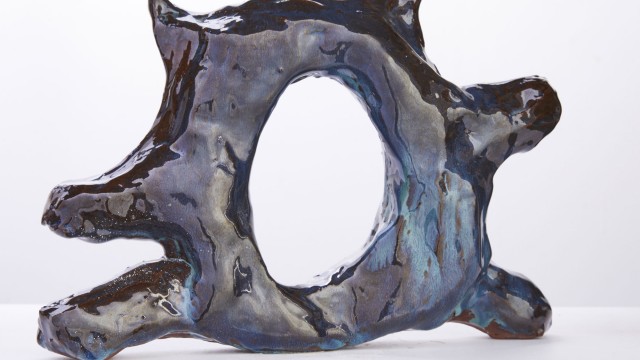
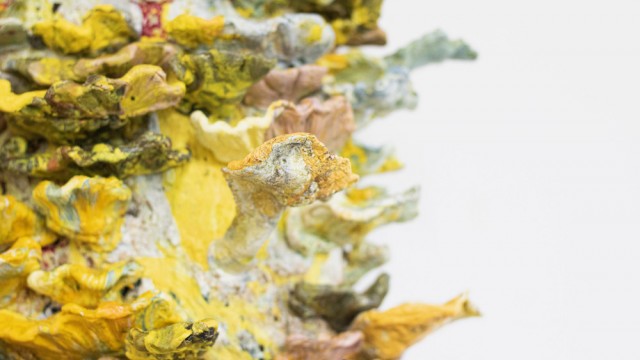
Chrystal Rimmer’s practice is an ecopoetic elegy — an echo of making with the living beings and forms of her surroundings that reflects upon shared cycles of loss, decay and rebirth. Within the cast creases of seaweed and folded wings of her sculptures, her latest exhibition, Upwelling, captures material impressions of the Earth’s current era, a period beset by mass species migration and the losses of climate change.
David Abram, author of The Spell of the Sensuous (1996) and Becoming Animal: An Earthly Cosmology (2010), describes this current epoch as the ‘Humilocene’. Pointing out the shared origins of ‘human’ and ‘humility’ in the Greek humus meaning ‘soil’, Abram uses the linguistic equivalent of archaeology: etymology, to argue for a humble grounding of humans with the earth. Borrowing the phrase ‘The Humbling’ from Dark Mountain’s project scholar, Dougald Hine, Abram posits that we are at a poetic inflection point, where our words and actions have the potential to shift our ecologies Rimmer’s practice offers a hopeful example of such a humbling. With a gentle sensibility, the maker invites the viewer to share in a tender regard, a soft attention towards the world around them.
Attention, attendre, tendre, tenir – to await the tender holding.
**********
Sensitive and sensing she paces the shore, the memory of an acorn held in her breast.
‘Listen…’, the falling seed had said as it tumbled from the boughs above and landed in her lap. Falling unexpectedly out of season, the maker felt it prudent to heed its silent lesson. She made a promise in that moment, her first creation of this story, to listen as often and as deeply as she could — a promise made to the fragile and fleeting through the poetry of making.
Letting the tendrils of wisdom take root, she headed home to the sand, air and ocean of Yuin country. It is here that we find her wandering, following the traces of lost things washed up at the ocean’s edge. ‘Waste’, they call it. Though to her, these disregarded gifts hold the lessons of creation she yearns to learn.
She lets the empty-full sound of salty wind guide her. Calves submerged, her hands comb grains of sand in the shallows of the water. Her fingers casually interlace with fronds of seaweed detached from far-flung seabeds. The ocean leaves dance to the rhythm of the tide. She feels them like the clasp of new love. Laying the briny weeds upon the shore she draws them in her sketchbook and when the ebb of lines naturally draws to a close, she carries the branches home.
In the studio, she asks questions of her new companions, watching and learning how they move, shift and change. She learns of their epic migration. Like salmon returning home, they have coursed against the warmth of ocean currents in reverse, washing up as unexpectedly as they were removed. The words ‘change’ and ‘climate’ reverberate in the small space as the fronds begin to ferment in the heat. As the weeks fold, the maker lets the plants draw themselves, casting their material echoes in silicone then bronze.
Our artist returns then to the cove once more, this time turning her ear to the ground. At the cusp of the dunes, she finds a bed of crumbling earth. ‘What is it?’ she asks, as the ancient people did, touching the earth with her hand. La main, handmade, human, humus, clay. ‘Wild’, she reads. ‘Situated’, says another. The clods of distant time and place cupped between her palms; a bountiful seam to a ceramicist’s hand. Patiently, she kneads the crumbling soil into dough. Once complete, she returns to the sand to show her new creation to the ocean, imagining what the vast body of water might think. Her offering feels small by comparison. Humbled, she tucks her head and returns to walking. Slowly, patiently, listening.
In the thick silence that falls when looking, she spots a moth on the sand. Her giant wings lie lifeless, breathed only by the ocean wind. A clutch of eggs rests crumpled in the distance. The nod of the artist’s humility turns into grief as she softly carries the paper-winged creature home. Laying it beside the branches of weeds, the soft dusty brown mirrors the colour of burnished copper. She venerates the loss of the mother moth in metal.
The artist makes her way back to the shore’s edge once more, soothed by the repetition of returning. She lets herself sink into it, pools of water gathering around her feet as if the ground and her body were crying in sympathy with each other. Solace, this is what she is searching for. Solace in small things.
Lost in thought, the floating backbones of cuttlefish bump into her ankles. She picks up a Styrofoam-like skeleton, the wings of the creature’s spine opening like a book. She starts to draw then, digging moth memories into soft bone. Cupping carving and clay in palms of prayer, she casts their stories, pressing earth into voids of absences. The lives of lost things embedded in new creation.
This is the poetry of making; imagination, memories and materials folding time and place.
Poiesis, making, material poetry, matter, Mother, earth.
Sadhbha Cockburn is an artist, writer
and fellow lover of moths.
sadhbha.com @sadhbha.c
David Abram, Tema Milstein and José Castro-Sotomayor. 2020. "Interbreathing Ecocultural Identity in the Humilocene." In Routledge Companion to Ecocultural Identity, Edited by Castro-Sotomayor, Tema Milstein and José. Routledge.
Listen
Chrystal Rimmer
A giant kelp is torn from their underwater forest.
They float across the ocean to come to rest before me.
Lifting their gleaming, limp body from the sand, I lay them in a grey plastic bag.
Tenderly,
I piece their body back together, every frond, limb and bladder.
I cast a spell in wax,
clay
and bronze.
The moth finds me the same way.
The night before, I dreamt of her—
how she flew across a different ocean, struggling against the currents
of unusually warm winds.
She confused the red-brick toilet block for a cave, mistaking the violent halogen globe for the moon.
How dare it.
I find her flittering
on the frigid, dank floor.
I lift her to a tree. She camouflages.
the tree knew what shade, texture and colour,
and the moth said,
me too.
For the cuttlefish,
only their skeletons float to shore. Against the blackened sea,
their bones are mirrors.
I make their skeletons into vessels, for the moth.
At dusk,
Beneath the branches of an oak,
I watch hundreds of fruit bats ascending the canopy.
The trees speak to one another. Perhaps the bats.
Perhaps us?
An acorn
falls into my lap.


Chrystal Rimmer
Upwelling
October 22-November 14, 2026